

The Allure of Trapiche Emeralds: Nature's Masterpiece

Updated: Apr 12
What is a Trapiche Emerald?
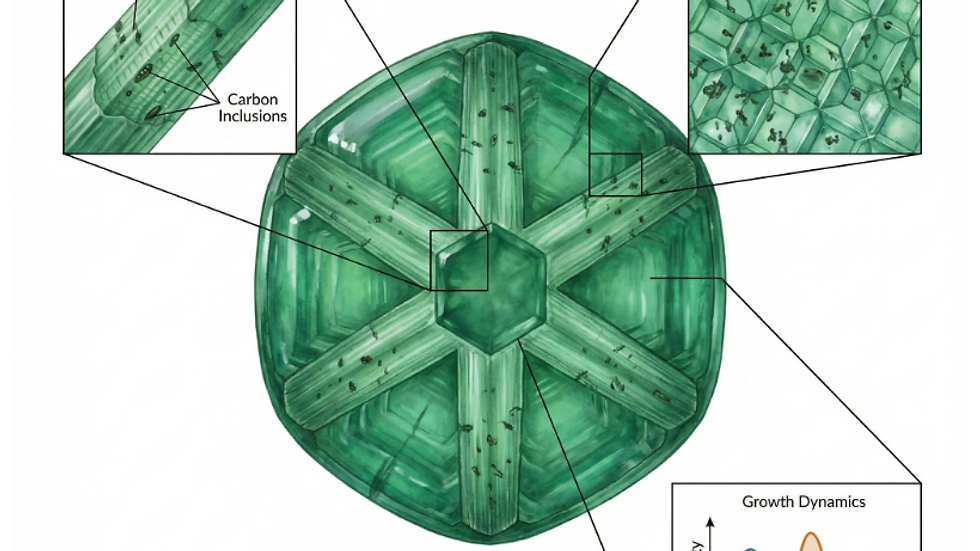
A Trapiche emerald is a rare variety of Emerald that shows a distinct six-rayed star pattern inside the stone.
According to research and documentation from the Gemological Institute of America, this pattern forms during crystal growth, not after. The name “Trapiche” comes from a Spanish sugar mill wheel, which the pattern closely resembles — a central core with spokes radiating outward.
How Does That Star Actually Form?
This is where it gets interesting. As the emerald crystal grows, it doesn’t always grow uniformly. Instead, it develops in separate growth sectors — like slices of a pie. Between these sectors, impurities — often carbon-rich material — get trapped, forming those dark radial lines.
So what you’re seeing isn’t a pattern added later…it’s literally a map of how the crystal formed.
This is something GIA has highlighted repeatedly: inclusions don’t always reduce value — sometimes, they define the gemstone.

Why Always Six Sides?
Emerald belongs to the mineral family Beryl, which crystallises in a hexagonal system. That’s the key. The six sides of the crystal structure naturally lead to six growth directions, which is why Trapiche emeralds almost always display a six-rayed pattern. It’s not random — it’s crystallography doing exactly what it’s meant to do.

Where Are They Found?
Trapiche emeralds are most famously found in Colombia, particularly in regions like Muzo and Coscuez. These deposits are known for producing some of the finest emeralds in the world — and occasionally, these rare structural anomalies.
They’re not common. Not even slightly. Which is why when you see one…you remember it.
Are They Valuable?

This is where it gets nuanced — and very interesting from a valuer’s perspective. Trapiche emeralds don’t follow the traditional emerald grading rules.
You’re not just judging:
colour
clarity
transparency
You’re also judging the pattern itself:
how symmetrical it is
how sharp the spokes are
how well-defined the sectors appear
Some Trapiche emeralds are more opaque, which would normally lower value… But here? That same “imperfection” is what makes it desirable.
Why This Matters in Gemmology

Trapiche emeralds are a perfect reminder of something I always say:
You’re not just looking at a gemstone — you’re looking at its history.
This isn’t about perfection. This is about formation. It’s geology, chemistry, and time — all frozen into one stone. And in this case…nature didn’t just grow a crystal. It left a signature.
The Unique Appeal of Trapiche Emeralds
So, why do we find Trapiche emeralds so captivating? It’s not just their beauty. It’s the story behind each stone. Every Trapiche emerald is unique, with its own history and formation process. When you hold one, you’re holding a piece of the Earth’s story.
Imagine the conditions that led to its creation. The pressure, the time, the elements all coming together to form something so stunning. It’s like nature’s artwork, crafted over millions of years.
Collecting Trapiche Emeralds
For gem enthusiasts, collecting Trapiche emeralds can be a thrilling adventure. Each piece offers a glimpse into the natural world and the geological processes that shape our planet.
When looking to add a Trapiche emerald to your collection, consider the following:
Authenticity: Always seek certification from reputable sources.
Quality: Look for well-defined patterns and vibrant colors.
Provenance: Knowing where your emerald comes from adds to its story.
Caring for Your Trapiche Emerald
Once you have your Trapiche emerald, you’ll want to take good care of it. Here are some tips:
Avoid harsh chemicals: Clean with mild soap and water.
Store properly: Keep it in a soft pouch or box to prevent scratches.
Regular checks: Inspect for any signs of damage or wear.
The Future of Trapiche Emeralds
As gemmology continues to evolve, so does our understanding of these unique stones. New techniques in mining and treatment may change how we view and value Trapiche emeralds.
However, one thing remains certain: their allure will never fade. They will always be a testament to nature’s creativity and the beauty of the Earth.
If I showed you this without context, you’d probably think it’s man-made. But now you know — this is one of the best examples of natural crystal growth doing something extraordinary.
And this one?


Comments